Network audit
Review diagrams, asset records and operating data.
 Consortiumof digital technologies
02 / Consortium expertise
We develop digital calculation models for water and wastewater networks, from source-data review and asset inventory to calibrated scenarios and practical reconstruction recommendations. Official utility references confirm the delivery experience of Ekolas Research and Production Centre.
Who it is for
We work with territorial communities, government authorities, municipal utilities, engineering organisations and responsible businesses.
We adapt the solution to real data, regulations, resources and client-team responsibilities. Delivery covers audit, requirements, design, implementation, training and support.
Scope
Modules are refined after reviewing source data and project goals.
Review diagrams, asset records and operating data.
Structure data on pipes, manholes, pumps, tanks and valves.
Represent actual water and wastewater operating modes.
Compare the model with measured pressure, flow and level data.
Test failures, switching, connections and future loads.
Prepare measures for resilience, efficiency and staged development.
Outcomes
How we work
The approach is adapted to the client’s data, infrastructure and responsibilities.
A calculation is useful only when source data reflects the real structure and operation of the network. We review topology, diameters, materials, elevations, pumping equipment, valves, reservoirs and demand connections. Uncertain sections are recorded separately and a verification programme is prepared, allowing the client to understand the confidence level behind each scenario and recommendation.
Model results are compared with measured pressure, flow, level and pumping-station operation. Differences can reveal diagram errors, undocumented connections, changed pipe characteristics or unusual equipment behaviour. A calibrated model becomes a practical engineering tool for testing emergency modes, new connections, operational changes and reconstruction options rather than a one-off theoretical calculation.
We compare pipe replacement, looping, pump schedules, pressure zones and future loads. Wastewater studies can cover sanitary and storm systems, pressure mains, gravity sewers and pumping stations. Results are presented so utility specialists can relate each measure to priorities, budget and delivery sequence, making the model useful for both immediate operational decisions and long-term capital planning.
Official references cover work in Sloviansk, Vyshhorod, Boryspil, Kherson, Uzhhorod, Nikopol, Yuzhne and Novodonetske. The Nikopol document confirms surveying 9,485 sewer manholes, network inventory and hydraulic modelling. These records are explicitly attributed to Ekolas Research and Production Centre and are not automatically represented as consortium-wide delivery experience.
Related projects
Each case states whether the experience belongs to the consortium or a specific founder company.
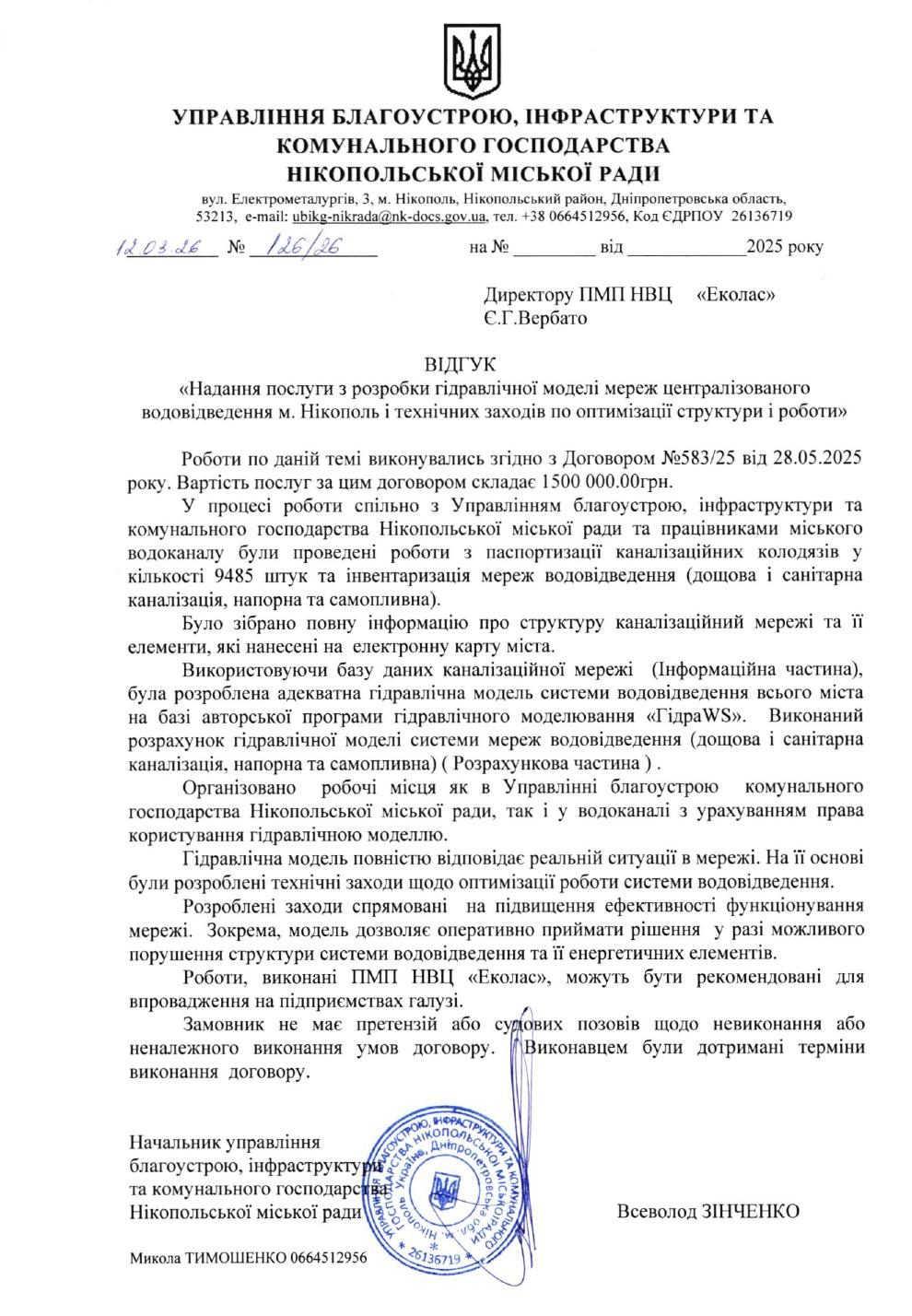 Experience of Ekolas Research and Production Centre
Surveying 9,485 manholes, network inventory and a hydraulic model of the municipal system.
View project →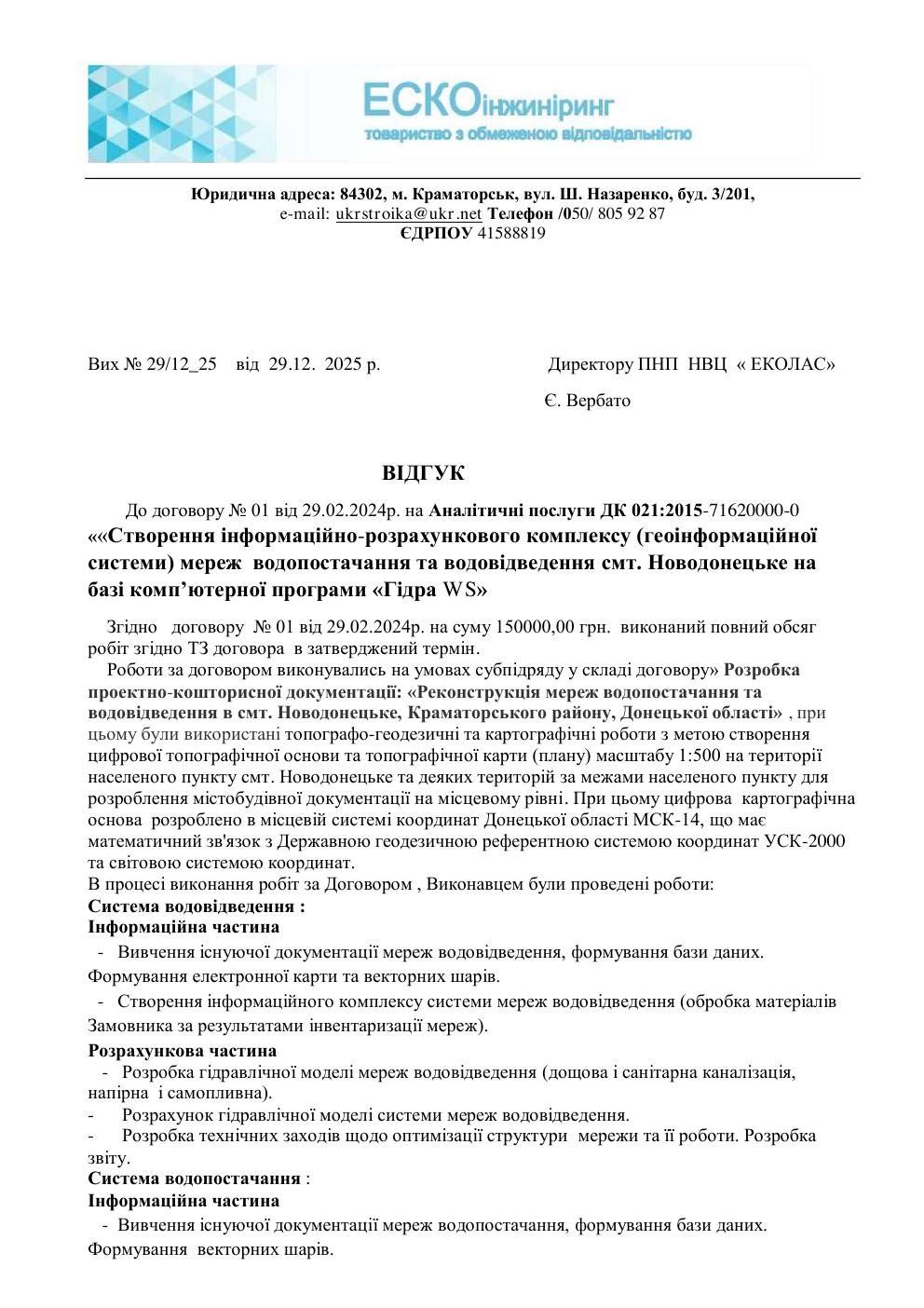 Experience of Ekolas Research and Production Centre
An information and calculation suite, digital topographic base and hydraulic modelling.
View project →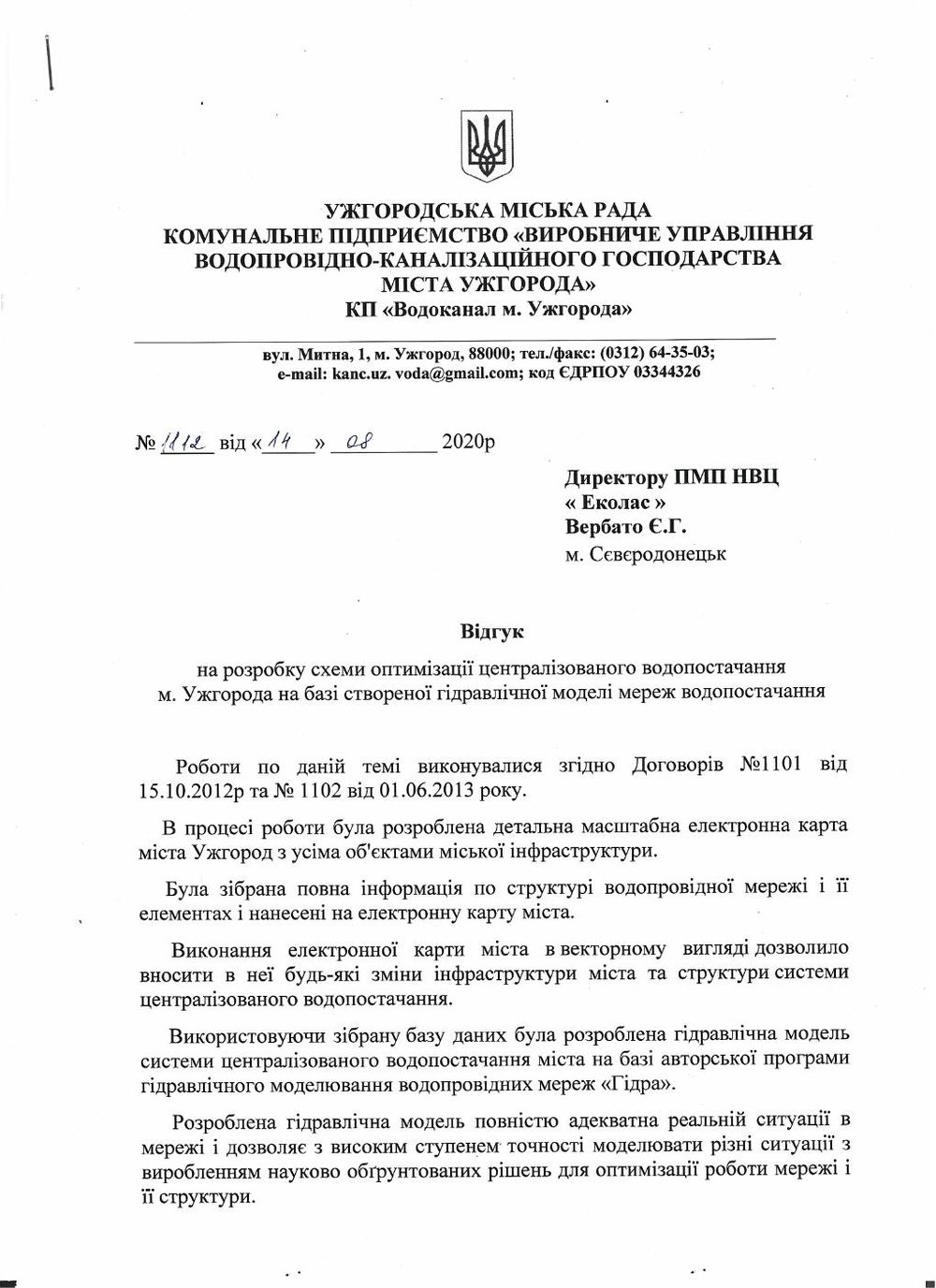 Experience of Ekolas Research and Production Centre
A centralised water supply optimisation scheme and GIS based on the Hydra suite.
View project →Documented evidence
Scanned letters open in their original form.
The official document confirms network inventory, surveying 9,485 manholes and model development.
Open document ↗Ekolas Research and Production CentreReference concerning optimisation of the centralised water supply system.
Open document ↗Ekolas Research and Production CentreReference concerning the network hydraulic model and operational optimisation.
Open document ↗Practical questions
Network diagrams, asset records, elevations, pump modes, demand data and available measurements; gaps are identified during the audit.
Yes. The scope can include sanitary and stormwater systems, pressure and gravity networks, and pumping stations.
Yes. Handover format, licensing, training and future updates are defined in the contract and technical brief.
To prepare a proposal, the client can provide the available network diagram, a description of the problem, known measurements and the decision the model should support. We identify usable data, field-verification needs and justified detail. Control scenarios, recommendations, software, database handover and training are agreed explicitly. The result is not only a calculation file but a repeatable method for testing assumptions, selecting investment measures and keeping the model current after the contract, so engineering knowledge remains available to the utility team.
IT OTG
Describe the context, expected outcome and timing. We will assemble the right team and propose the next step.
Discuss a project↗