Data collection and validation
Review diagrams, asset records, operating modes, consumption, development patterns and required field surveys.
 Consortiumof digital technologies
02 / Consortium expertise
The consortium delivers the complete development cycle for centralised water supply and wastewater optimisation schemes: source-data collection, field surveys, hydraulic modelling, technical and economic comparison of scenarios, an implementation programme and support through approval. The work is structured in line with the current Order No. 986 of the Ministry for Development of Communities and Territories of Ukraine, dated 12 June 2025.
Downloadable materials
Original PowerPoint presentations. The available decks are currently in Ukrainian.
Strategy, expertise and consortium readiness for integrated projects.
Download presentation ↓PowerPoint · 13 MBDigital recovery of data, networks and water-supply operations after damage.
Download presentation ↓PowerPoint · 13 MBHydraulic modelling, spatial data and BIM for infrastructure recovery.
Download presentation ↓PowerPoint · 6.1 MBSanitary and stormwater systems, calculation models and development scenarios.
Download presentation ↓Current regulatory basis
The procedures for centralised water supply and wastewater optimisation schemes have been effective since 12 September 2025. The water supply procedure is registered under No. 1183/44589 and the wastewater procedure under No. 1184/44590.
View the official document in the Ukrainian Parliament database ↗Who it is for
We work with territorial communities, government authorities, municipal utilities, engineering organisations and responsible businesses.
We adapt the solution to real data, regulations, resources and client-team responsibilities. Delivery covers audit, requirements, design, implementation, training and support.
Scope
Modules are refined after reviewing source data and project goals.
Review diagrams, asset records, operating modes, consumption, development patterns and required field surveys.
Build and calibrate network models and test baseline, future and emergency operating modes.
Assess district-level water demand, water balance, demographic change and planned development.
Compare reconstruction, pressure zoning, pumping regimes, redundancy and network expansion.
Address power loss, failures, wartime threats, contamination events and continuity of service.
Define priorities, phases, capital and operating costs, funding options and approval materials.
Outcomes
How we work
The approach is adapted to the client’s data, infrastructure and responsibilities.
Order No. 986 dated 12 June 2025 approved separate procedures for centralised water supply and wastewater optimisation schemes. It was registered by the Ministry of Justice on 11 August 2025 under No. 1183/44589, with the wastewater procedure also registered under No. 1184/44590. We structure inputs, scenarios and deliverables around these current requirements. The cycle covers audit, field surveys, a digital asset base, modelling, alternatives, economic assessment, implementation programming and approval support.
A scheme must describe the real system with verifiable data. We collect information on sources, assets, pipes, pumping stations, reservoirs, valves, treatment facilities, discharges, customers and operating modes. The analysis considers development density, planned growth, district-level demand, water balance, losses, load variation and metering quality. Uncertain records are identified, and field checks or measurements are planned for critical areas.
The model represents pressure, flow, levels, sewer filling and equipment operation. Once calibrated, it compares the baseline with reconstruction and growth alternatives, including pipe replacement, looping, pressure zoning, pump operation, source redundancy, new development and treatment upgrades. Each alternative is assessed for technical effect, expenditure, energy use, environmental impact, sequencing and dependencies.
We assess power loss at water or booster stations, physical failures, communications loss, hostile action and chemical, biological, radiological or nuclear risks. Modelling can test emergency switching, pressure compensation, isolation of damaged areas and minimum supply for critical users. Findings become engineering, organisational and redundancy measures.
The scope may model how a contaminant enters and travels through a water network over time. Results support monitoring points, isolation zones, warning procedures, sensor locations and automated shut-off valves. This complements laboratory control and emergency planning by testing the spatial and temporal logic before an incident.
Measures are ranked by urgency, effect, cost and feasibility. They may include operational changes, metering, dispatch systems, efficient equipment, reconstruction, backup power, protection of critical nodes and long-term expansion. Financial analysis supports budgets, investment programmes and applications for international loans or grants. The client receives datasets, models, maps, calculations and a phased action plan.
Related projects
Each case states whether the experience belongs to the consortium or a specific founder company.
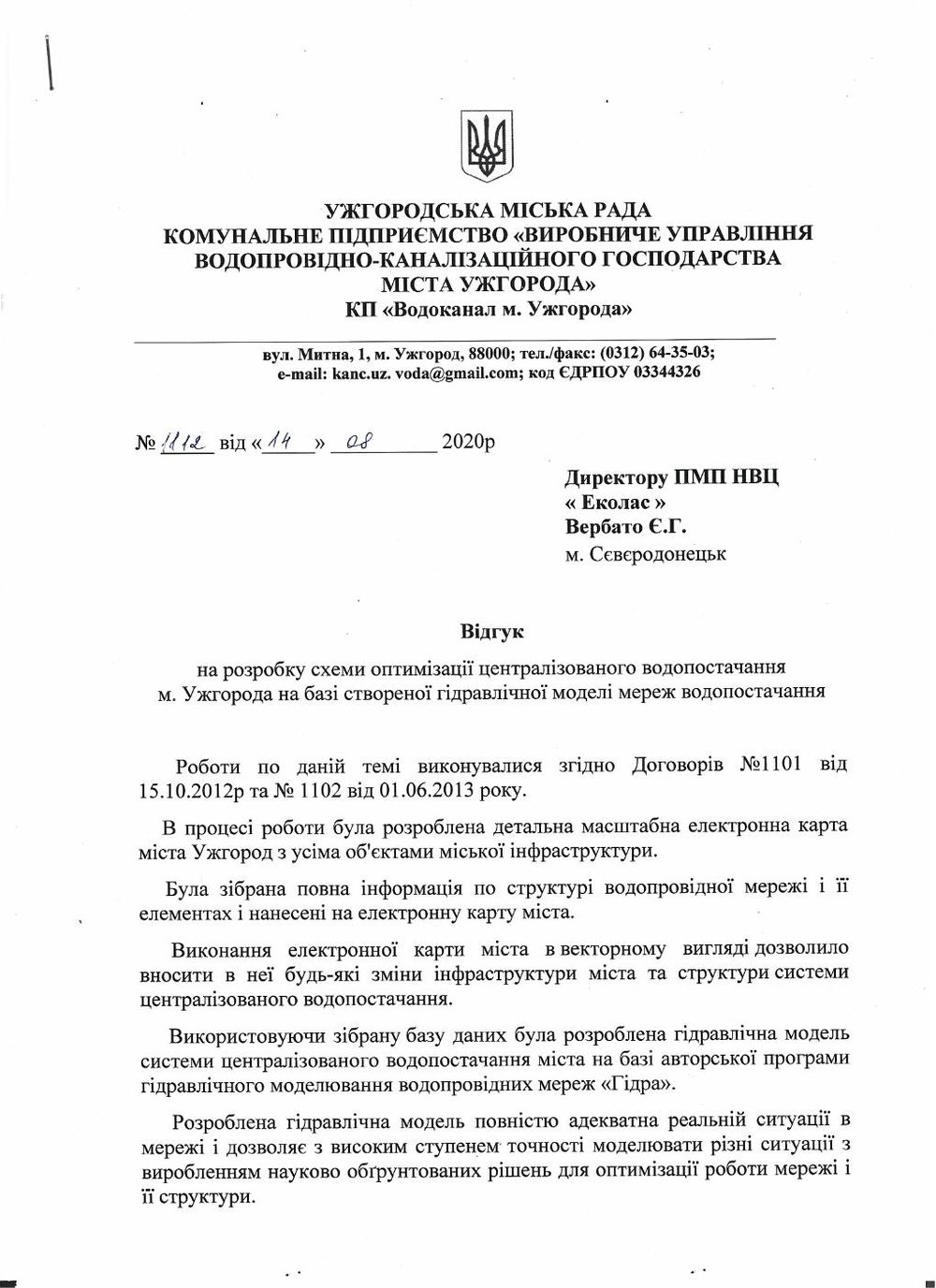 Experience of Ekolas Research and Production Centre
A centralised water supply optimisation scheme and GIS based on the Hydra suite.
View project →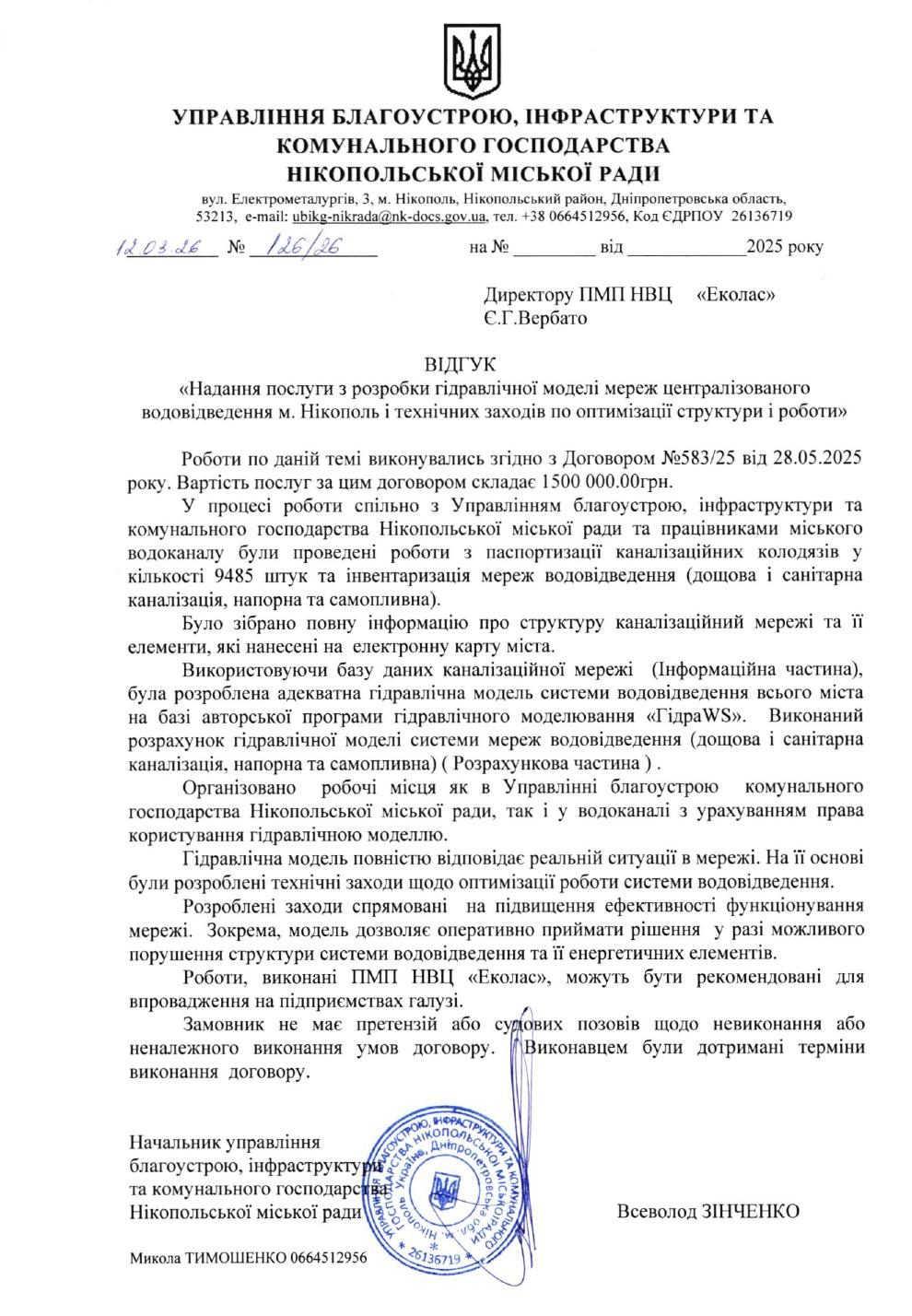 Experience of Ekolas Research and Production Centre
Network inventory, surveying 9,485 manholes and a hydraulic model of the municipal system.
View project →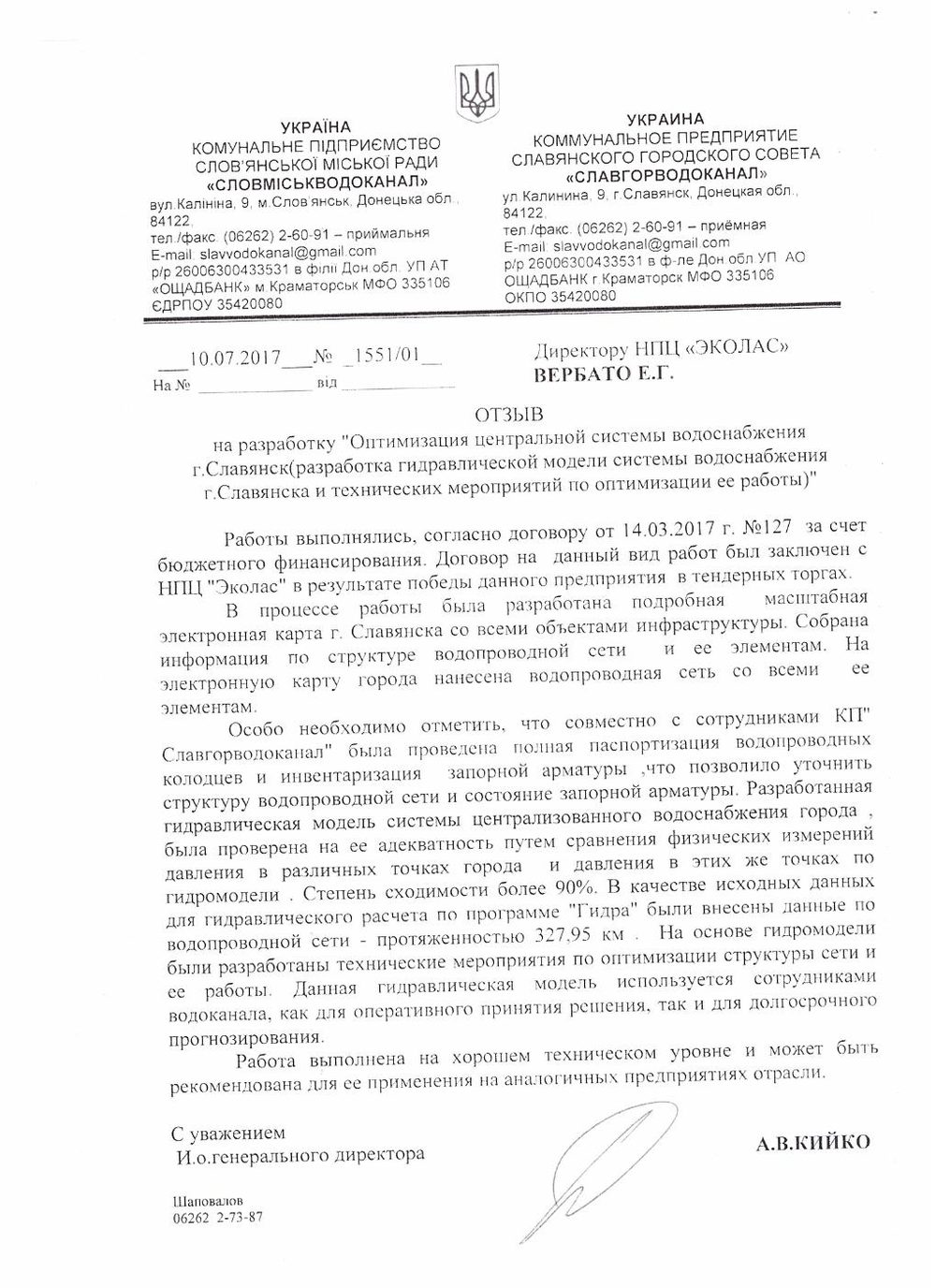 Experience of Ekolas Research and Production Centre
Documented experience in developing solutions for a centralised water supply system.
View project →Documented evidence
Scanned letters open in their original form.
Official reference covering an optimisation scheme and implementation of an information and calculation suite.
Open document ↗Ekolas Research and Production CentreReference concerning optimisation of the centralised water supply system.
Open document ↗Ekolas Research and Production CentreThe document confirms network inventory, asset surveying and development of a hydraulic model.
Open document ↗Practical questions
Yes. The official Ukrainian Parliament database lists it as current and effective from 12 September 2025.
The model is one tool. A scheme also covers forecasts, alternatives, risks, efficiency, economics, priorities and implementation.
Yes. The territory, system relationships, data and calculation boundaries are defined under the applicable procedure.
Yes. We prepare materials, respond to comments and support the client through the required process.
The starting package may include current diagrams, asset passports, metering data, pumping regimes, development plans and a list of priority problems. The initial audit identifies missing evidence, field work, territorial boundaries and scenarios. We then agree the schedule, interim deliverables, cooperation with the utility and community, and acceptance process. The consortium manages the full cycle from source-data structure and calculations to the implementation programme and approval support, keeping engineering choices, risk, economics, energy efficiency and funding within one accountable process.
IT OTG
Describe the context, expected outcome and timing. We will assemble the right team and propose the next step.
Discuss a project↗